


In her 2025 annual report on the Environmental Bill of Rights (EBR), Ontario’s Auditor General, Shelley Spence, found that the Ford government failed to disclose Greenbelt and environmental risks when it exempted Highway 413 from public consultations.
Spence stated that, “A 2021 Impact Assessment Agency of Canada Report raised concerns about how Highway 413 could affect species at risk, wildlife corridors and rivers.” Previous Ministry of Transportation studies also identified that the proposed Highway 413 route would pass through the Greenbelt and other significant environmental features and would impact species at risk.
Despite this, when the Ford government sought public feedback on exempting the project from the EBR via Bill 212, the Reducing Gridlock, Saving You Time Act, 2024 and the Highway 413 Act, the Auditor General found that “The Environment Ministry did not describe these impacts in the proposal notice and did not provide any information about whether these impacts would be assessed through the new process, or how significant impacts would be mitigated.”
The EBR is provincial legislation that ensures Ontarians have a say in significant environmental changes made by the government, requires that notices of changes and their impacts be posted on the Environmental Registry of Ontario (ERO) for prescribed ministries, and provides an opportunity to appeal certain decisions.
The Field & Shutter Press contacted the Ministry of the Environment and Transportation for a response to the Auditor General’s findings, but did not receive a response by publication. The article will be updated if a response is provided.
Environmental Risks of Highway 413
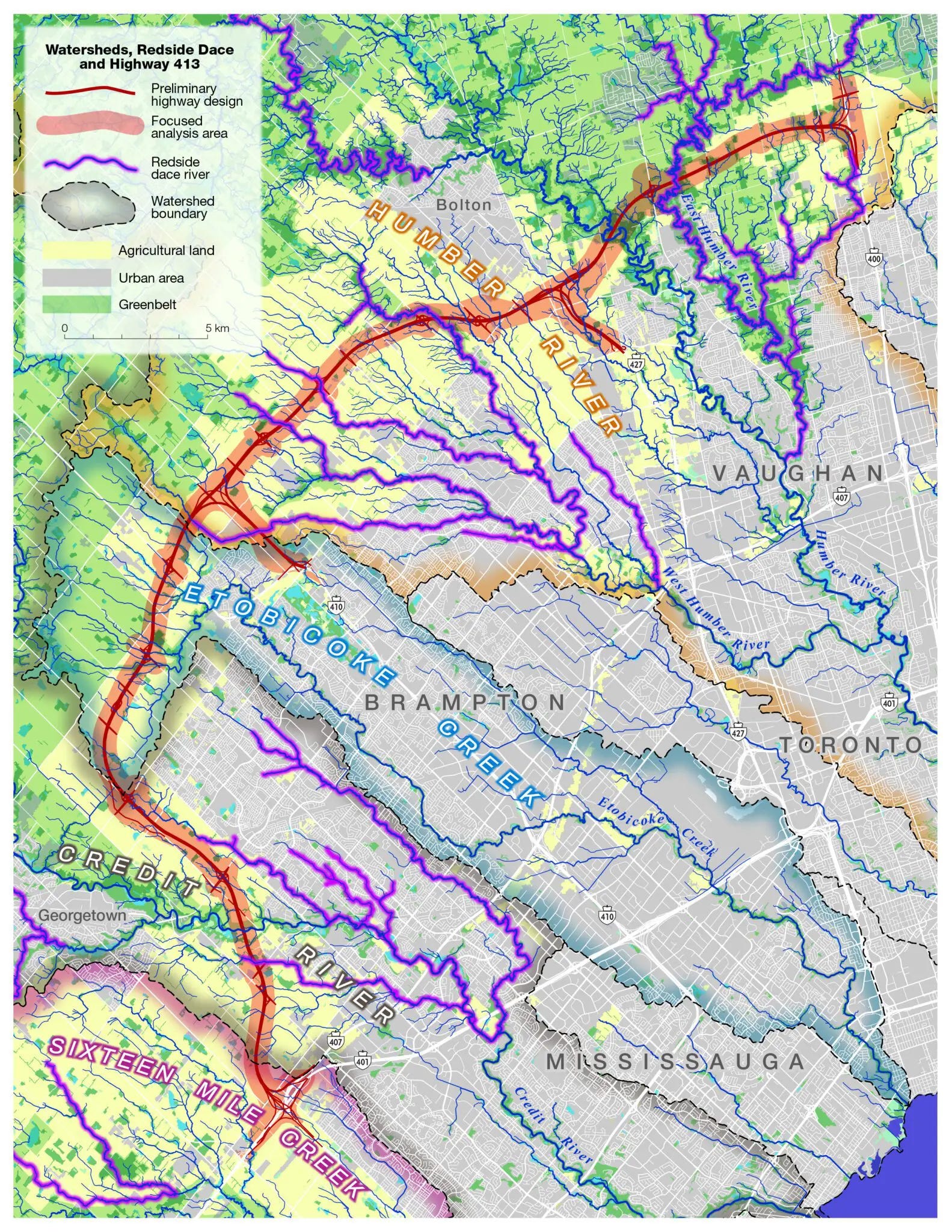
The proposed route for Highway 413 will cut through three major watersheds: the Humber River, Etobicoke Creek, and Credit River, which threatens to cause the local extinction (extirpation) of species like the Redside dace, an endangered species both provincially and federally.
The Ontario government’s webpage on the Redside dace explains the impacts of development on the species, stating that, “Development can alter stream flow and shape, cause excessive amounts of sediment to enter the water, result in the removal of streamside vegetation which the species needs for cover and food, and to moderate water temperature.”
Tony Morris, Ontario Nature’s Director of Conservation Policy and Campaigns, said that if Ontario continues to lose its biodiversity, it will make the province more susceptible to the effects of climate change, likening species loss to a Jenga tower. “Keep removing them. Eventually, that tower will collapse.”
Earlier this year, the federal government announced it had issued a Habitat Protection Order under the federal Species at Risk Act regarding the Redside dace. Phil Pothen, Ontario Environment Program Manager & Counsel at Environmental Defence, explained in a press release that the order “prohibits anyone from doing anything that would destroy any of the habitat value of the mapped rivers, creeks and tributaries that Redside dace depends on.”
The Humber River and its tributaries have been identified as critical habitat for the Redside dace, with Pothen also stating in the release, “it’s now clearly illegal to build the parts of Highway 413 that cross them.”
However, Pothen also warns that these protections are not absolute. The federal government could still allow the extirpation of the Redside dace by issuing permits “to destroy the habitat” or by “intentionally failing to enforce the law,” instead, allowing harmful activities such as sprawling development to take place.
It would also cut through Ontario’s Greenbelt, a region the government’s website says “protects farmland, communities, forests, wetlands and watersheds.” Environmental Defence reports that more than 400 acres of the Greenbelt, including prime farmland, would be lost to the highway.
In 2022, the Ford government sought to open portions of Ontario’s Greenbelt to housing development through a process that several independent watchdog reports later found to be flawed and to favour certain developers. The resulting controversy led to the reversal of the decision, the resignation of a cabinet minister and other staff, widespread political backlash, and the launch of a Royal Canadian Mounted Police (RCMP) criminal investigation that remains ongoing more than two years later.
The Auditor General also found in her 2025 report that “over one-fifth” of the proposals posted on the ERO lacked information on the expected environmental impacts.
Highway 413 Act Exempts Project from Environmental Bill of Rights
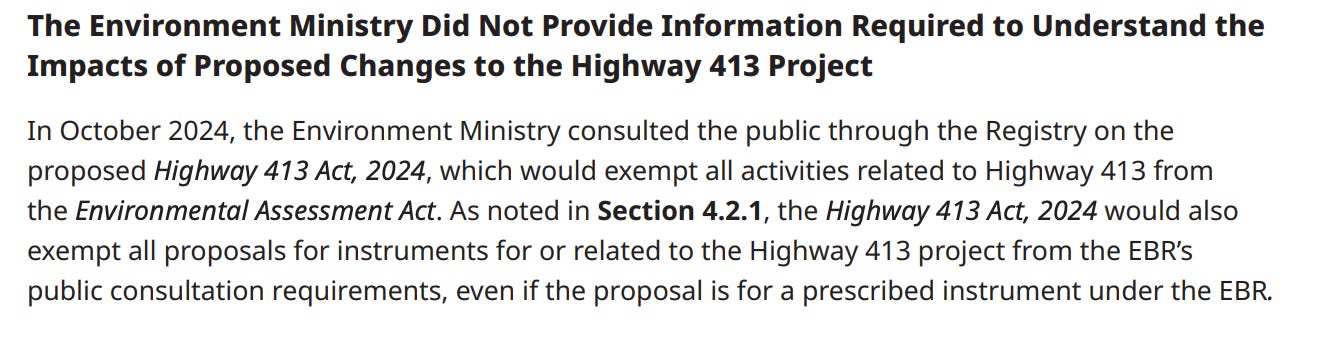
The Highway 413 Act exempted the highway project from the EBR, meaning that the usual rights granted under the EBR no longer apply to the Highway 413 project.
Mike Marcolongo, an Associate Director at Environmental Defence Canada, said the exemption undermines public participation, “This government doesn’t really care about public input, unfortunately, and is removing all appeal tools.”
The Auditor General did note in her report that the Highway 413 Act includes requirements for public consultations under the Environmental Impact Assessment Report for the project, but stated it “does not give Ontarians the same rights that they have under the EBR.”
The Auditor General also highlighted in her 2025 report that “the Province has been taking actions that had rarely or never been taken,” since the EBR was enacted in 1994. With Tony Morris saying, “There’s always been implementation and performance issues, but the actions of this government are unprecedented and fundamentally undermine the intent of the EBR.”
Draft Environmental Impact Report Published
A draft of the Environmental Impact Assessment Report for Highway 413 was recently made available, with a section of the project website reading: “The Highway 413 draft Environmental Impact Assessment Report (EIAR) is now available for comment from December 1, 2025, until January 6, 2026.”
Mike Marcolongo said the report is approximately 1,700 pages long and that the Ontario government is giving the public and First Nations “roughly a month to review the documentation over the holiday period.”
That approximation includes the draft and its related appendices.
The Auditor General noted in her report, “The public has an interest in participating in decision-making about Highway 413 that may affect the environment, including any instruments needed to carry out the project.”
Government’s Rationale
The Highway 413 project website states, “The province is committed to maintaining strong environmental oversight of Highway 413 to minimize impacts on natural terrain.” The province is also “taking steps to expand the Greenbelt to protect environmental, groundwater and agricultural resources for future generations,” according to the website, despite removing it from the public consultation process under the EBR.
The Ford government has maintained that building Highway 413 is necessary to reduce gridlock and get drivers to their destinations faster.
“Highway 413 will help meet the needs of our growing province as a prosperity corridor that will create thousands of good-paying union jobs during the construction phase and make life easier and more convenient for millions of drivers in the GTA and across Ontario. We’re getting it done,” said Premier Doug Ford in a press release announcing the project in April 2024.
In a recent release surrounding Highway 413, Minister of Transportation Prabmeet Sarkaria said, “Building Highway 413 will help protect Ontario against U.S. tariffs and global economic uncertainty by improving the movement of people and goods and keeping more than 6,000 workers on the job during construction.”
However, Mike Marcolongo said in a statement that a recent report authored by Environmental Defence and Transport Action Ontario, which uses Highway 413 as a case study, “demonstrates that putting $14 billion (the estimated cost of this highway) toward public transit investment instead of the highway would move more than double the number of commuters per hour.”
The Ford government has not publicly released a total cost estimation for Highway 413.
Opposition Raises Concerns in Legislature
In the Ontario Legislature during question period on December 3, MPP Peter Tabuns, the NDP Environment Critic, said to the Premier, “The Auditor General made it clear in her report yesterday that the government doesn’t follow or respect the law regarding environmental consultation, the Environmental Bill of Rights.” He then asked, “Why doesn’t the government respect the law or the environment?”
The Premier did not respond. Instead, the Minister of the Environment, Conservation and Parks, the Hon. Todd McCarthy, replied, quoting a portion of the Auditor General’s finding that the public had been informed and able to participate, and adding “our ministry and our government, through dedicated outreach, focused consultation sessions and specialized working groups, consults and listens and acts in accordance with the will of the people.”
Environment Critic, and Liberal MPP Mary-Margaret McMahon, said in an emailed statement to The Field & Shutter Press that the Ford government is wasting the public’s time.
“Time is a resource, and this government unabashedly steals people’s time when they invite them to submit well-researched, and passionate comments under the ERO just to ignore their input, or not give them enough information to understand what they are reviewing in the first place, if they even ask for it at all,” MPP McMahon wrote.
Editor’s Note: This article was updated on January 7, 2026, to include a watershed impact map detailing the proposed Highway 413 route and its intersection with Redside dace habitat. The map was added after initial publication following the receipt of formal permission for its use. The reporting remains unchanged.
Follow the Field & Shutter Press
Instagram | YouTube | BlueSky
Have a tip, story idea, event, or want to appear as a guest column? Contact us.