


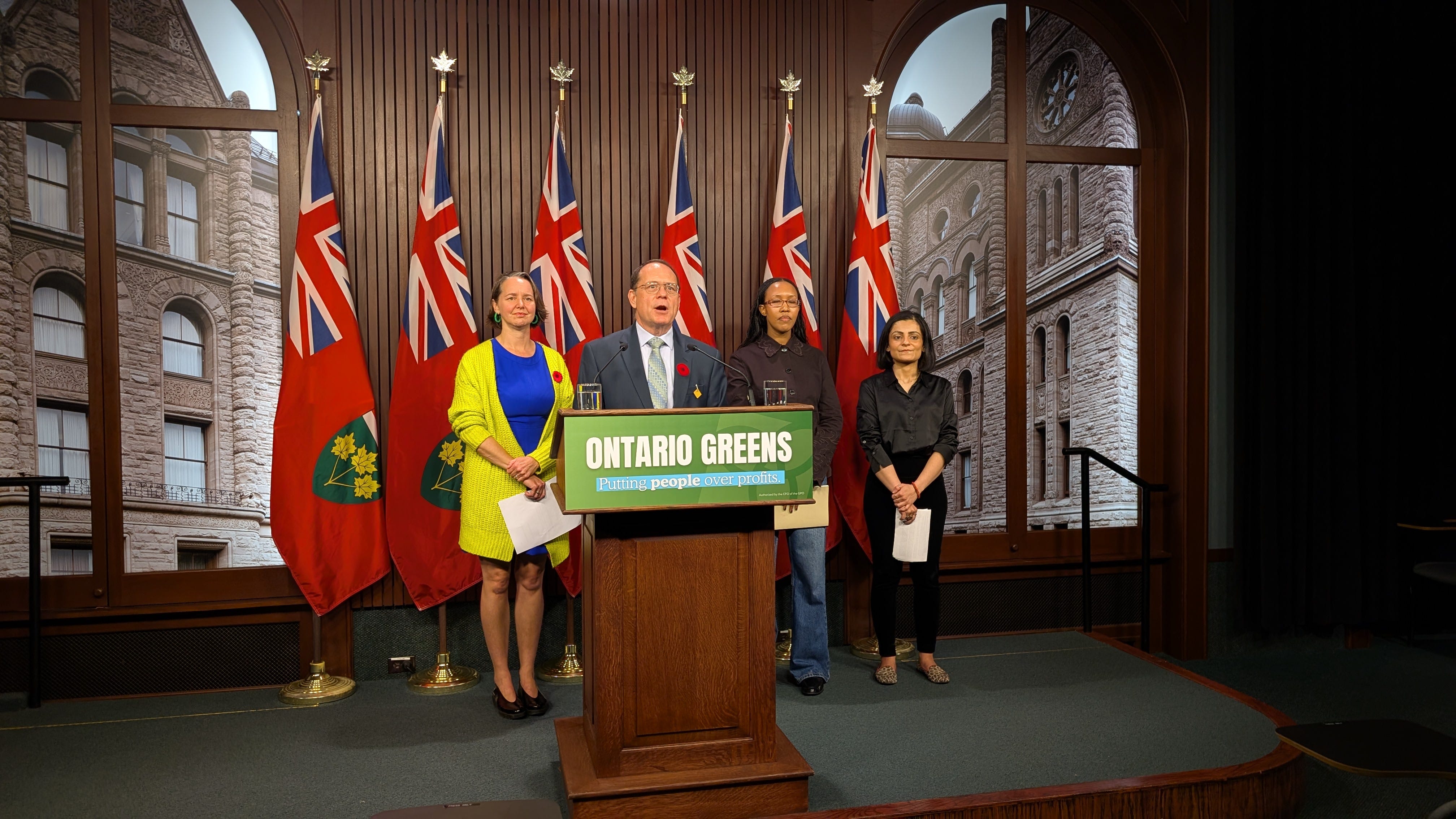
On November 3, Ontario Green Party Leader and Guelph MPP Mike Schreiner, alongside Deputy Leader and Kitchener Centre MPP Aislinn Clancy, introduced a private member's bill that, if passed, would impose an indefinite stop on the construction and expansion of artificial intelligence (AI) data centres across the province, while a Council recommends legislative changes.
Bill 146, the Moratorium on Artificial Intelligence Data Centres Act, 2026, would establish a pause, prohibiting the "building or increasing the computational capacity of artificial intelligence data centres until the moratorium is lifted," according to the bill's explanatory note.
It defines an AI data centre as a specialized facility designed for the “computationally intensive tasks of training or running artificial intelligence systems or advanced machine learning models.”
The bill would also establish an advisory committee, known as the AI Safety Advisory Council. The Lieutenant Governor in Council would appoint its members, including academics, non-profit organizations, and experts in artificial intelligence, water, land use and planning, and environmental matters.
The committee would prepare a package of “suggested legislative amendments designed to achieve several objectives related to artificial intelligence data centres,” according to the bill. Additionally, they would “monitor the state of the law and assess whether the objectives have been met.”
They would post the suggested amendments on a Government of Ontario website, along with delivering them to the Minister of Economic Development, Job Creation and Trade and the Minister of Environment, Conservation and Parks.
An Angus Reid Institute survey of 4,417 Canadian adults, published on October 7, found that 64% believed their provincial government should limit the development of large data centres; more specifically, 69% of Ontario respondents favoured limiting development. The survey asked about data centres being built or proposed to support AI, cloud computing and other digital services, rather than focusing on AI facilities alone.
Among Canadians who favoured limiting development, 51% cited high water use as a reason. The survey also asked whether “Artificial Intelligence is a force for good in society,” with 58% disagreeing, 14% unsure, while only 28% agreed.
10 key objectives must be addressed to lift the moratorium
The proposed moratorium would remain in place until the AI Safety Advisory Council is satisfied that amendments to Ontario’s laws have achieved the 10 goals outlined in the act.
The 10 objectives would not themselves establish new operating requirements for data centres. Instead, they would guide the Council's proposed legislative and regulatory amendments and serve as benchmarks for determining when the moratorium can be lifted, which are:
1. Artificial intelligence data centres must demonstrate that they will not increase utility bills for residents and businesses in their host communities.
2. Artificial intelligence data centres must not increase fossil fuel use, require new fossil fuel infrastructure or increase peak electricity use.
3. Access to water that is needed for drinking or agricultural use shall be prioritized over access to water that is needed for artificial intelligence data centres.
4. No artificial intelligence data centres may be built or have their computational capacity increased until a local watershed impact assessment has been completed.
5. There must be defined limits on the electricity, water, noise and emissions generated by artificial intelligence data centres in Ontario, and compliance with those limits must be subject to independent monitoring and public reporting.
6. Artificial intelligence data centres must not be built on farmland.
7. Communities that are impacted by the building or increase in computational capacity of an artificial intelligence data centre must have the power to approve or reject the building or computational capacity increase and must have mechanisms to recover any increased infrastructure costs.
8. Artificial intelligence data centres must provide community benefits through binding agreements with the community that have clear outcomes and penalties.
9. All aspects of artificial intelligence data centres must be governed by digital sovereignty requirements that ensure Canadian control of the centre and its data, along with mandatory disclosure of any legal or privacy risks that may arise in other jurisdictions.
10. No government subsidies may be provided for building or increasing the computational capacity of artificial intelligence data centres.
The bill says that once the Council is “satisfied that amendments to the state of the law have met the objectives,” it would publish a statement and the moratorium would be lifted. However, it does not establish a deadline for the Council to provide its recommendations, nor does it impose any requirements on the government to enact them.
This means the proposed moratorium could remain in place indefinitely if the committee determines that the 10 objectives have not yet been achieved.
Penalties, land restrictions, and mandatory reporting
The bill would also give the Minister of Agriculture, Food and Agribusiness the power to “make orders requiring persons to dispose of farmland or their interest in farmland” if it had been purchased or otherwise acquired to build or expand an AI data centre in contravention of the moratorium. The Minister could also issue orders prohibiting the purchase of farmland for these purposes.
The legislation would introduce penalties for violations of the moratorium and for failing to comply with an order. Individuals found guilty of an offence could face fines of up to $500,000, while corporations could face fines of up to $1 million.
Directors or officers who authorized, permitted or concurred in the commission of a corporate offence could also be held individually liable.
Both the Minister of Energy and Mines and the Minister of Environment, Conservation and Parks would be required to publish an annual report, which would describe the current and forecasted consumption of water and energy, noise levels, on- and off-site greenhouse gas emissions, any electronic or chemical waste, thermal outputs and wastewater discharge, funding sources and jobs created or lost because of AI data centres.
Further, it would amend the Planning Act so that Ministerial Zoning Orders could not be used if they would “have the effect of permitting the building or increase in computational capacity of an artificial intelligence data centre until the moratorium is lifted.”
It would also amend the Special Economic Zones Act, 2025, which allows certain designated projects and trusted proponents to receive exemptions from provincial and municipal laws. The proposed amendment would ensure that those exemptions could not be used to circumvent the AI data centre moratorium.
Greens, advocates call for caution as province prepares data centre push
During the press conference announcing the legislation, Schreiner criticized the Ford government’s approach to data centre development, arguing that the province’s proposed Data Centre Playbook, a draft document intended to guide data centre development across Ontario, lacks sufficient safeguards.
“If you look at the government’s playbook, there are so many holes in it, you could drive a truck through it,” he said.
Concerns around data centres have been raised over their potential impacts on water consumption, electricity demand, emissions and the environment.
The Ontario Greens were joined at the press conference by Bea Bhardwaj, a systems governance researcher with a focus on AI infrastructure, and Ilham Abdulkadir, an organizer with Water Watchers, a grassroots not-for-profit focused on water protection and climate justice.
Emphasizing the importance of Canadian data sovereignty, one of the act’s objectives, Bhardwaj said, “Data centres in Canada run by US-based operators make our data subject to US legal demands, which deprives us of our right to true digital sovereignty.”
Abdulkadir explained, “Ontario has both an opportunity and a responsibility to get this right before the damage is done. Our water, our environment and our communities cannot be an afterthought.”
The Field & Shutter Press reached out to the Premier’s office for comment on the bill’s introduction and any response to the criticism by Schreiner; a response was not received before publication.
However, Ontario’s Minister of Economic Development, Vic Fedeli, told Global News that the Ford government expects to approve its first batch of AI data centre projects “sooner rather than later.”
The Ford government’s proposed Data Centre Playbook framework, announced in August, is intended to guide decisions on electricity grid connections for new data centre projects. Premier Doug Ford said his government will ensure AI Data Centres “play by the right rules and pay the full cost of electricity.” The Ford government also said it is only providing “non-financial support to attract investments” in data centres.
They will only “advance data centre projects” that meet the province’s “strict environmental standards around water consumption and noise” and will prioritize projects with a closed-loop cooling system.
The Ford government also passed legislation, the Protect Ontario by Securing Affordable Energy for Generations Act, which it said gives the Minister of Energy and Mines the “final decision” on which large electrical-use facilities are allowed to connect to Ontario’s electrical grid; it has said it will “only consider projects that accelerate economic growth with significant community investments, on terms that prioritize Ontario’s interests,” according to the August announcement.
The Ontario NDP, the official opposition, was contacted for comment by The Field & Shutter Press and asked whether it would be supporting the bill; however, no response was received before publication. Meanwhile, Global News reported that Marit Stiles, Leader of the Ontario NDP, had suggested her party would be willing to support the bill.
The bill has passed its first reading and was ordered for a second reading. Before the bill could become law, further steps and debates are needed.
The proposed moratorium would take effect only if the bill receives Royal Assent.
Follow The Field & Shutter Press
Instagram | YouTube | BlueSky
Have a tip, story idea, event, or want to appear as a guest column? Contact us.