


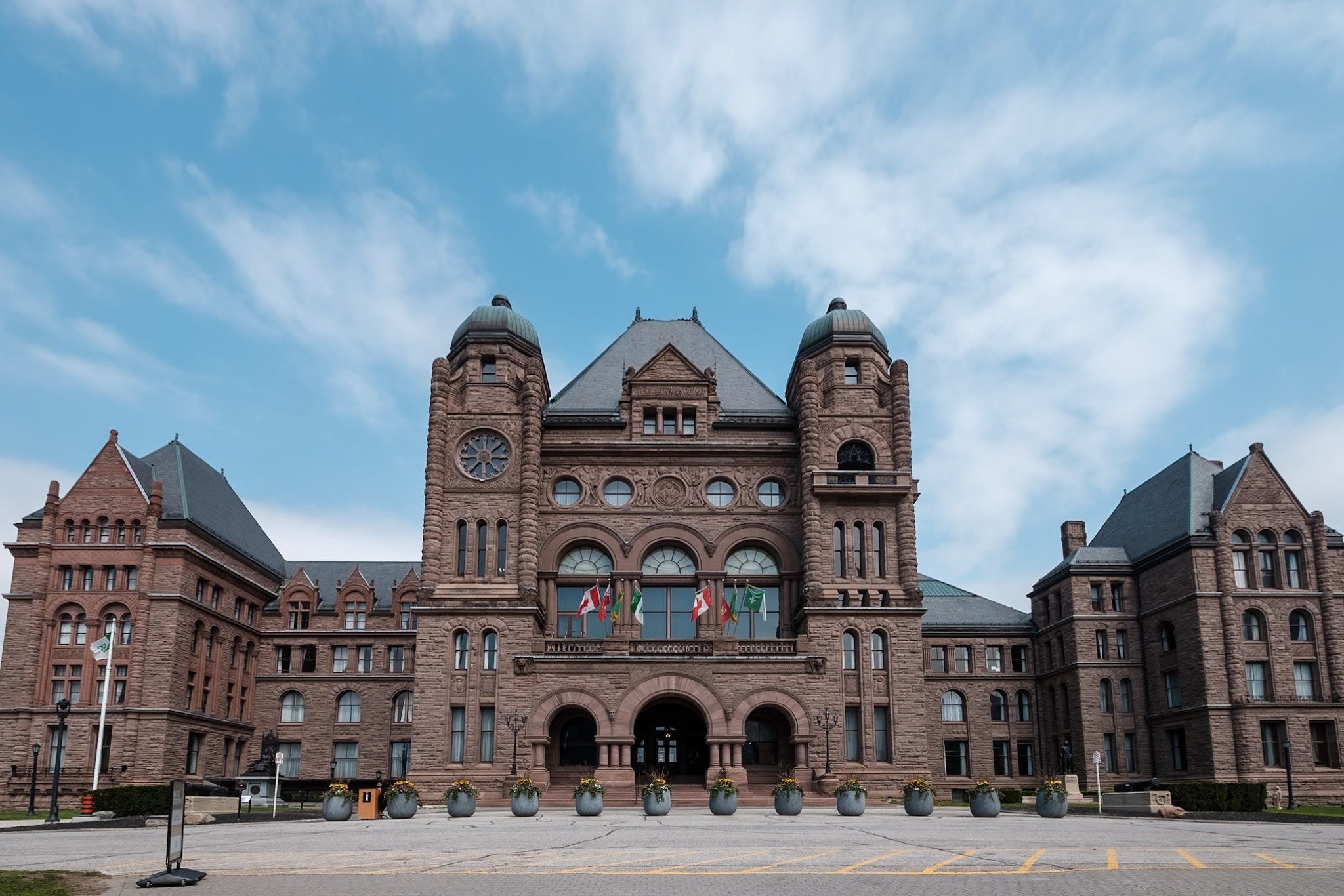
During the first day back of the fall session at Queen’s Park, October 27, the Ford government introduced Bill 140, the Building Ontario Faster Act, an omnibus bill which proposes major changes to Ontario’s Environmental Bill of Rights (EBR).
The proposed legislation, specifically Schedule 8 of the bill, would eliminate several mechanisms that allow residents to challenge environmental decisions and demand accountability for violations. It would also repeal requirements for ministries to develop and consider Statements of Environmental Values when making decisions.
“For all intents and purposes, it leaves the statute with little more than the title: Environmental Bill of Rights. The content would no longer reflect anybody’s idea of an environmental statute that purports to protect environmental rights,” said Joseph Castrilli, a lawyer with the Canadian Environmental Law Association (CELA).
The Ford government has said it’s updating the EBR to “streamline outdated processes that duplicate other avenues for public input,” according to a document released by the Ministry of Red Tape Reduction.
The Environmental Bill of Rights, enacted in 1994, establishes a framework for public participation and accountability in government decision-making affecting the environment. The proposed changes could reduce public participation and accountability that the act was intended for.
Removing key references
Currently, the Environmental Bill of Rights lists one of its purposes as protecting, conserving and, where reasonable, restoring the environment. If passed, the bill would amend that purpose by removing reference to restoring the environment.
The Field & Shutter Press reached out to the Ministry of the Environment, Conservation and Parks (MECP), but they did not comment in time for publication.
The EBR also requires Ministries to develop Statements of Environmental Values to guide policy decisions. Using the MECP as an example, Castrilli explained that they’re supposed to act preventively in making decisions that affect the environment, and act in a precautionary manner.
However, under the proposed changes, the Ministry is seeking to repeal the requirements for prescribed ministries to develop and consider these statements and values in their decision-making.
Castrilli told The Field & Shutter Press that Statements of Environmental Values guide ministries’ environmental decision-making. He said tribunals had used them as a benchmark for assessing permits and other approvals, and that the Divisional Court had found this use reasonable. Their repeal, he argued, would remove an important reference point in the leave-to-appeal process.
The Ministry of the Environment, Conservation and Parks has indicated that impacts to the environment would still be considered.”Ministries consider environmental factors in their decision-making as appropriate and as a matter of good governance and best practice with respect to policy development,” it said.
However, Castrilli said that “the bill should be withdrawn, and in fact, the recommendations for reform that were made in the 2024 Law Commission of Ontario report should actually be introduced.”
Recommended reforms
In 2024, the Law Commission of Ontario published a report titled “A new environmental bill of rights for Ontario”, which provided over 50 recommendations for ways the province could update the Environmental Bill of Rights, with a focus on Statements of Environmental Values, Leave to Appeal and public participation.
“For years the Ford government has eroded (The EBR’s) strength to avoid accountability and to fast-track destructive projects,” said Ontario Green Party Leader Mike Schreiner regarding the changes. The Auditor General of Ontario also reported similar concerns in her 2025 report on the EBR, stating “the Province’s actions, inaction and decisions in recent years are eroding Ontarians’ EBR rights and opportunities to participate meaningfully in the government’s environmental decision-making.”

That finding was also published by the Law Commission of Ontario, which wrote, “Many reports, court decisions, and analyses have documented this erosion, and noted consistent EBR non-compliance by government ministries, erosion of
EBR public participation rights, downgrading the role of the Environmental Commissioner, and other factors which suggest that the EBR has failed to fully meet its objectives.”
The Ford government has said the changes will “dramatically improve Ontario’s competitiveness within Canada and around the world, while retaining robust environmental protections and approvals processes.”
When asked if he believed the Ford government had implemented any of the changes, Castrilli responded, “No, actually, the recommendations were to improve the act, not eliminate it.”
Accountability measures removed
Currently, the Environmental Bill of Rights allows eligible Ontarians to seek to appeal certain government decisions involving environmental approvals. “There are also provisions that allow members of the public to seek government reviews of poorly working environmental approvals,” said Castrilli. Bill 140 would repeal parts which provide for Applications for Review and that set out the leave to appeal process.
“Losing the ability to seek leave to appeal under the requirements of the EBR is a major blow to environmental protection in the province,” explained Castrilli.
The MECP, however, has said on the Environmental Registry of Ontario, “The change would provide greater certainty for project proponents that have already undergone a public consultation process and obtained government approvals. With these changes, government decisions could be implemented with greater certainty for businesses, organizations, and others seeking approvals.”
The proposed legislation would also eliminate another method of public accountability: investigations. Two members of the public can request an investigation if they believe a person, group or company has violated an environmental act designated the EBR. However, under the newly proposed legislation, this wouldn’t be possible.
The MECP has stated that the public would still be able to report alleged contraventions to the attention of the relevant ministries or the Spills Action Centre.
However, Castrilli explained that this would not replace the protections. “Having something in writing in a statute that says this is the process that has to be followed is far superior to, ‘Oh yeah, anybody can pick up the phone and call a ministry person.’”
When an investigation is completed, the EBR requires that the outcome be provided in 30 days, which Castrilli said would no longer exist.
He explained the CELA had made use of the investigation request process in their work. At least one request eventually led to charges. He said requests were rarely acted on by the government, but argued that this reflected government discretion, not a failure of the statutory process.
Notably, the CELA and the Ontario Municipal Water Association requested an investigation into Ontario’s allowable lead limits in drinking water, as Ontario allows higher than the Federal limits. The MECP refused to investigate in response, determining the public interest did not warrant an investigation.
The Field & Shutter Press asked the MECP what specific problems the government was seeking to address by eliminating Applications for Review and Applications for Investigation, and how many of these applications the ministry had received over the past five years. The ministry did not respond to these questions by publication time.
Losing the right to sue
Under the EBR’s Part Six, Ontarians have the right to take legal action against someone who causes significant harm to a public resource. The Ford government is proposing to remove this section, with the rationale that the section was rarely used.
“That was a part of the act that was not really functioning because there were too many obstacles embedded in the statute to allow members of the public to use it in the courts, and the LCO [Law Commission of Ontario] report focus was on, among other things, improving the requirements under Part Six so that it could become usable by the public,” explained Castrilli
As currently proposed, Bill 140 could see amendments to 21 Provincial Statutes ranging from transportation, bees, disability savings, labour and the environment.
However, Richard Lindgren, a member of the advisory committee on the Law Commission of Ontario’s report and lawyer with the CELA, warns that “The net result of Bill 140 will likely be more pollution, increased environmental degradation, and greater health risks for Ontarians. Bill 140 should be withdrawn.”
Feedback on these changes is being accepted until November 26 through Ontario’s Environmental Registry.
Follow The Field & Shutter Press
Instagram | YouTube | BlueSky
Have a tip, story idea, event, or want to appear as a guest column? Contact us.