


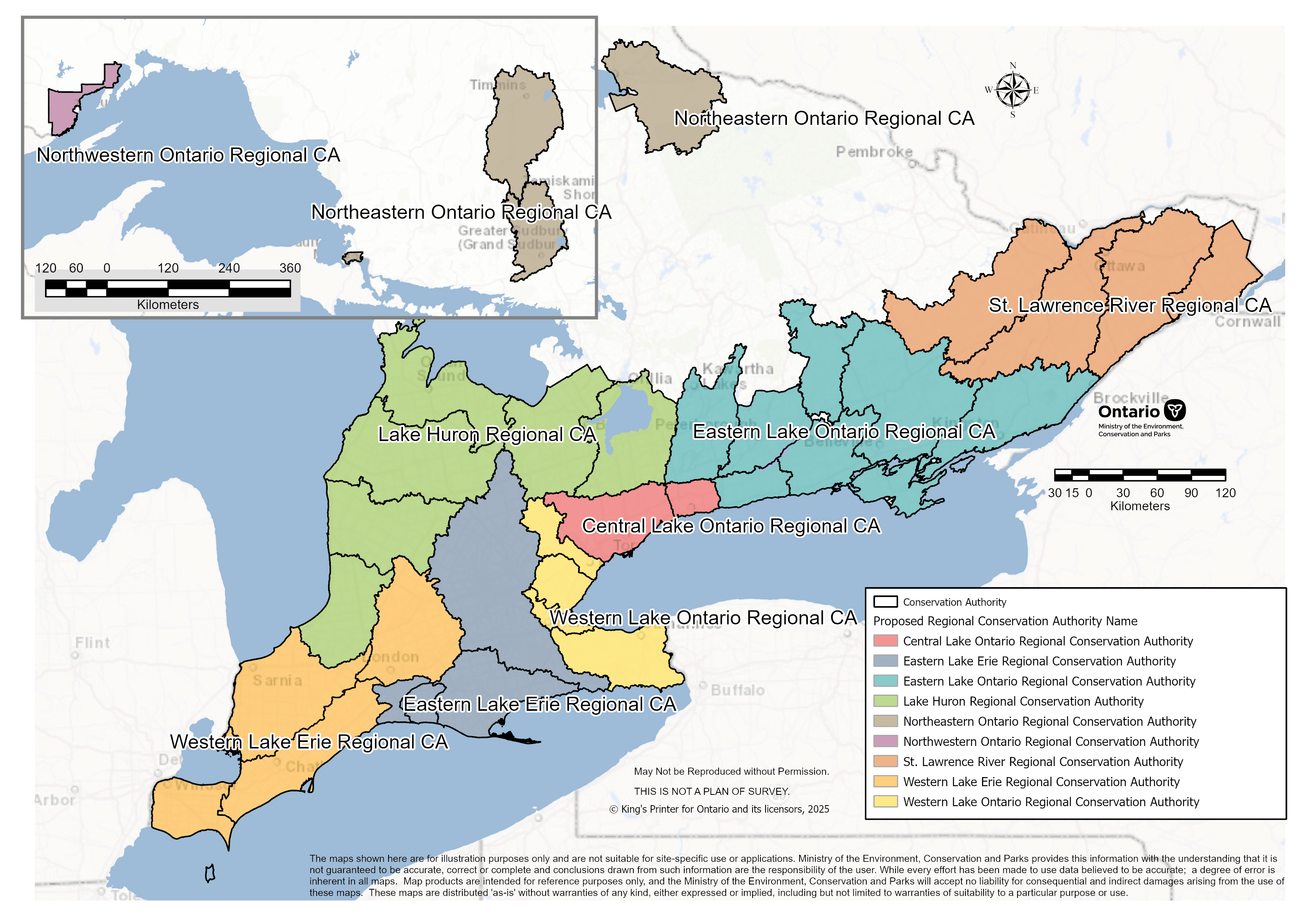
The Ford government passed Bill 97, the Plan to Protect Ontario Act, an omnibus budget bill, on April 23, with the Bill receiving Royal Assent on April 24. The province’s 36 Conservation Authorities will now officially consolidate into nine regional bodies, a move the province says will streamline approvals but critics warn could weaken local watershed management.
Locally, Conservation Halton and Credit Valley Conservation (CVC) will merge to form a new Western Lake Ontario Regional Conservation Authority, which would also absorb the Hamilton Conservation Authority and the Niagara Peninsula Conservation Authority. However, Conservation Halton officials have told The Field & Shutter Press that changes to day-to-day operations should be minimal for residents.
This follows a previous proposal to consolidate to just 7 Conservation Authorities, which drew significant criticism.
Conservation authorities are local agencies responsible for watershed management, flood prevention, environmental protection and development permitting across Ontario.
“Ontario’s improved approach would feature watershed-based regional conservation authorities operating under consistent provincial standards, modern tools and strengthened capacity – delivering stronger watershed management, flood resilience and better support for housing and infrastructure growth,” said Minister of the Environment, Conservation and Parks, Todd McCarthy, in a press release when the change was announced.
Credit Valley Conservation Authority’s Board “condemned” the move, saying as part of a press release that the proposed actions “disrupt one of the province’s most efficient and high-performing conservation authorities.”
Mayor of Halton Hills and a member of the CVC Board, Ann Lawlor, said in the same release, “local tax dollars and donations have created beautiful conservation areas. These local parks and trails should continue to be owned and managed by the people who paid for and use them.”
Critics warn conservation overhaul could weaken protections and heighten flood risks
NDP MPP and environment critic Peter Tabuns criticized the revised plan, calling it “yet another attack on our environment by the Ford government,” while saying that Ontario’s watersheds are unique and have varying individual needs, “that will fall by the wayside when haphazardly lumped together.”
Tabuns further stated that the “red tape” the Ford government is looking to streamline “are the regulations that keep Ontario and its ecosystems safe from contaminated water, flooding, and species loss.”
Leader of the Ontario Green Party, MPP Mike Schreiner, echoed those concerns, saying, “Every year, communities across Ontario face increasingly dangerous flood risks. Now, this government wants to sink millions into weakening protections.”
The province has said through a posting to Ontario’s Environmental Registry that the “important work that [Conservation Authorities] do to protect people and property from the risks of flooding and other natural hazards would not change.”
A coalition of critics, comprised of Ontario Nature, the National Farmers Union-Ontario and the Federation of Ontario Cottagers’ Associations, along with the newly formed Watershed Conservation Coalition, which is a group of 74 professional individuals with decades of watershed management experience they say, stated as part of a media backgrounder that the Ford government has “provided no evidence to support that consolidation will accelerate housing development, while still supporting public safety from natural hazards and the protection of natural, scientific and recreational lands.”
They also said of the change, “This sweeping consolidation and centralized political control will impede CAs’ ability to do their work effectively.”
The Ford government indicated that it consulted for 45 days “with conservation authorities, municipalities, general stakeholders, and Indigenous communities,” a process they say “included six regional workshops that engaged directly with conservation authority and municipal leadership,” between Nov 7 and Dec 22 in 2025.
As a result of those consultations, the province updated the proposal, moving from the proposed 7 Conservation Authorities instead to 9, to “accommodate areas with distinct geographies and development contexts, to better balance differing priorities across rural, urban and northern areas and improve alignment with watersheds and with source protection regions,” said an update on Ontario’s Environmental Registry.
Tony Morris, Conservation Policy and Campaigns Director for Ontario Nature, in response to the updated proposal, said to The Field & Shutter Press in an email that he was “disappointed that they continue to move forward with such a drastic overhaul and claim that this approach addresses concerns.”
Province says changes will streamline approvals
The Ford government said the changes are intended to address what it describes as a “patchwork” of standards, service delivery, data systems and administration across the province’s conservation authorities, according to a released document.
The province says differences in policies, fees, staffing, and technical capacity between authorities have created “unpredictable and inconsistent turnaround times for approvals,” leading to delays for builders, landowners, and farmers seeking permits.
However, it’s unclear how the new change will affect approvals, as Tony Morris said, “No business case has been provided on how this consolidation solves the problem the province is claiming exists,” while highlighting that “in 2024 the Conservation Authorities issued over 7,000 permits with 96% issued within timelines.”
Over 14,000 public comments received
During the public comment period on Ontario’s Environmental Registry regarding the change, over 14,000 submissions were received, which the province says “helped shape the government’s plan,” regarding the “final boundaries for regional CAs, governance of regional CAs, and the transition process.”
They said that the adjustment “from the proposed seven regional conservation authorities to nine” resulted from the feedback received.
However, Tony Morris from Ontario Nature noted that the update lacked any information regarding the nature of those comments, saying there was “no summary of, for, or against this proposal, with the information on changes in response to feedback vague.”
Something Morris said is “part of a pattern that we are seeing that the Auditor General has flagged. Ontarians’ rights to participate meaningfully in environmental decision-making are being eroded.”
The Auditor General of Ontario reports annually on the Environmental Bill of Rights, legislation intended to ensure Ontarians have the rights mentioned by Morris.

Conservation Ontario, a not-for-profit organization that represents the 36 current authorities, said in a letter of the original proposal, “Conservation authorities, municipalities, and Conservation Ontario remain concerned that the scale of the proposed regional consolidation may be too large to preserve successful watershed management in Ontario.”
The Field & Shutter Press reached out to Conservation Ontario for a response to the changes, but did not receive one prior to publication.
Another submission was from the Ontario Federation of Agriculture, which represents farmers, saying, “Ontario has 19 Source Protection Regions (SPRs) and a total of 38 Source Protection Areas (SPAs) established under the Clean Water Act, 2006.”
They previously proposed utilizing the existing Source Protection Regions as a model for the new boundaries, saying, “We believe creating 19 Regional CAs based on the Source Protection Regional (SPR) structure would better preserve a watershed-based approach while offering more geographically coherent boundaries and stronger local accountability than a system of only seven Regions.”
Tyler Brooks, Director of Communications and Stakeholder Relations for the Ontario Federation of Agriculture, said to The Field & Shutter Press that their initial submission “still broadly reflects [the Ontario Federation of Agriculture’s] perspective,” after the updated proposal.
Mixed feedback, says Ontario’s Home Builders Association
The Ontario Home Builders Association describes itself as the “leading voice for the province’s building, land development, and renovation industry,” stating they represent “4,000 member companies across 28 local associations,” according to their website.
In their initial response to the changes, the association said they received feedback from “builders, developers, engineers, planners, and consultants,” reflecting a “wide diversity of perspectives.” The very same groups that the province has said the changes will benefit.
One of the consistent themes identified by the members was to “carefully distinguish between the objectives of conservation authority reform and the mechanisms proposed to achieve those objectives.”
While there was “broad alignment around the need for greater consistency,” they state there was “no uniform view that boundary consolidation alone will deliver these outcomes.”
The association further explained that many of the “day-to-day challenges with conservation authorities arise not from the number of authorities or the configuration of their boundaries,” but instead from how “policies are interpreted, how files are reviewed, how timelines are managed, and how duplication between agencies is addressed.”
However, some see it as a “necessary structural reform” that could “enable improvements in these areas if implemented thoughtfully and with appropriate safeguards.”
They say the differing views of their members do “not reflect disagreement on environmental protection or public safety,” but instead, “reflects differing assessments of institutional risk, governance effectiveness, and the likelihood that consolidation will meaningfully improve outcomes without introducing new challenges.”
When reached for comment on the updated proposal, Kirstin Jensen, Vice President, Policy, Advocacy & Relationships for the Ontario Home Builders Association, said that the ultimate goal of the Association is “to ensure that conservation authority processes continue to protect communities and natural hazards while also supporting timely housing and infrastructure delivery across Ontario.”
New provincial agency to oversee transition
The province created the Ontario Provincial Conservation Agency last fall to oversee the transition. The agency will coordinate the consolidation process, which the government says is expected to be completed by early 2027.
“The Ontario Provincial Conservation Agency would lead a smooth, well‑supported transition, ensuring conservation authorities have the tools and resources they need every step of the way to deliver effective watershed management programs, meeting the needs of today and the future,” said Hassaan Basit, Ontario’s Chief Conservation Executive, and former CEO of Conservation Halton.
The Ford government has indicated that “$3 million, beginning in 2026,” would be provided to the agency, with the money supporting “conservation authorities as needed during the transition period.”
So what’s happening for Halton Region?
In an email to The Field & Shutter Press in March, Conservation Halton Communications Specialist Tamanna Kohi said, “After the planned consolidation occurs in early 2027, Conservation Halton will become part of the Western Lake Ontario Regional Conservation Authority that continues to operate as an independent public body with a municipally appointed Board.”
The Consolidation is currently planned for completion by February 1, 2027.
Kohi also explained that proposed changes should have “no impact on how our local communities interact with [Conservation Halton] and the programs and events they know and love.”
In a March 30 release, the organization further stated, “the valued programs and services currently offered by Conservation Halton, including planning and permitting activities, educational initiatives, stewardship opportunities, recreational spaces and programs, and support for local environmental projects, will remain accessible and uninterrupted throughout this transition period.”
They state that for now they “remain focused on our mandate to safeguard people and property from floods, managing and enhancing watershed resiliency through watershed-based resource management programs, and connection communities with nature through conservation areas and park programs.”
The Conservation Halton Foundation, the charitable foundation that supports Conservation Halton, has said on its website that there will be no changes to its operations.
“Conservation Halton Foundation is a separately incorporated, registered charity, overseen by its Board of Directors,” the website explains. It further states that, “The Foundation will continue to monitor developments and work closely with Conservation Halton to support the programs and places that matter most to our community.”
Credit Valley Conservation did not respond to requests for comment from The Field & Shutter Press prior to publication on how the changes may affect its operations.
While locally the changes may be minimal in how residents interact with their conservation authorities, critics argue the province hasn’t shown how consolidation will solve the problems it identified, warning it could weaken local watershed management and leave communities more vulnerable to rising flood risks.
Follow the Field & Shutter Press
Instagram | YouTube | BlueSky
Have a tip, story idea, event, or want to appear as a guest column? Contact us.