


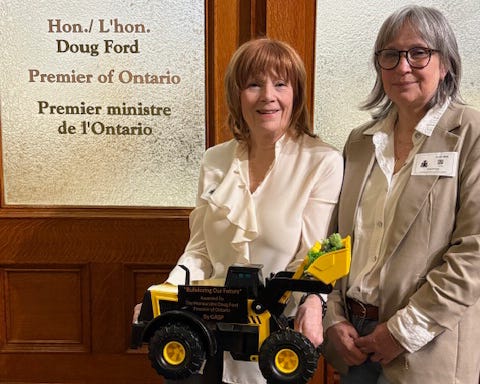
On March 12, at a press conference at Queen’s Park, Grand(m)others Act To Save The Planet (GASP) presented Ontario’s Premier Doug Ford with its “Don’t Bulldoze Our Future” award, criticizing what the group described as his government’s environmental decisions.
GASP describes itself as a grassroots environmental organization.
“It is always a pleasure to present an award to a recipient who deserves recognition for their good work and achievements serving their community,” said Sharon Sommerville of GASP, before adding, “but not today.”
She said GASP regrets “that we have to present the 2026 ‘don’t bulldoze our future’ award to our Premier, Doug Ford.”
Sommerville said that this award is “for his work to pave over thousands of acres of precious farmland, destroy critical woodlots that clean our air and wetlands that prevent floods, wasting apparently unlimited tax dollars in doing so.”
Premier Doug Ford was not present to accept the award in person. It was delivered to his office after the press conference.
The premier’s office did not respond to a request for comment prior to publication.
“We are here today because we are extremely concerned with Premier Ford’s policies that recklessly remove safeguards that protect our natural assets,” Kathy Geczi, a member of GASP, said.
Green Party Leader and Guelph MPP, Mike Schreiner, sponsored the press conference, saying of the award, “I’m glad to see members of our community stand up to the Ford government to fight for nature and for Ontario’s future,” adding, “Time after time, this government puts corporate interests above the well-being of everyday people and future generations.”
GASP was joined by Kevin Thomason from the Grand River Environmental Network and Dr. Richard Thomas, a natural resources management expert with over 40 years of experience.
Thomason highlighted the situation in Waterloo Region, where development is currently halted due to a water shortage, following the Ford government's approval of over 100 permits to take water in the region.
He called on the Ford government to “immediately implement a moratorium on water taking permits and new gravel pits.”
Green Party MPP for Kitchener Centre, Aislinn Clancy, submitted a letter to the Ministry responsible, stating, “About 80 per cent of our water used in our homes, schools, businesses and industries comes from underground sources.” She also said that “Approving industrial and commercial water-taking permits would put further strain on an already-stressed water system.”
It was also announced that GASP would be hosting a “Don’t Bulldoze Our Future” rally at Queen’s Park on March 26 from 12 pm to 1 pm.
Environmental record criticized
The group criticized Premier Ford for what they called a “constant attack on our land,” citing actions such as “removing municipal regulations and regional oversight, transferring provincial park land for development, expanding urban boundaries onto farmland, reducing the amount of greenspace in neighbourhoods, indiscriminately using Ministerial Zoning Orders that bypass municipal planning and community input, and creating Special Economic Zones that fast-track development without having to adhere to environmental, health, labour or safety laws,” said Victoria Creese of GASP.
Ford has also “weakened species’ protections by replacing the Endangered Species Act with the inadequate Species Conservation Act,” she said.
Ontario Nature, alongside 100 other nature and conservation-based organizations, submitted a letter to the Ford government when changes to the Endangered Species Act were first being proposed, saying, “The text and preamble of the Species Conservation Act creates an impression that it is purely performative and is not intended to prevent the ongoing decline of endangered species in practice.”
Under the new Species Conservation Act, “no migratory birds, aquatic species or species of special concern will be provincially listed,” with the reasoning being that the species “already receive federal protection under the Species at Risk Act (SARA),” according to a blog posted in January by Tony Morris, Conservation Policy and Campaigns Director for Ontario Nature.
“The new law would define animal ‘habitat’ to mean only the nest, den, or immediate area around it,” and “This would leave species that are already in decline due to habitat loss, without the basic things they need to survive,” according to a 2025 post from Ecojustice.
The Ford government, through an update to a public posting about the proposed change, said that the changes will “help speed up project timelines and provide greater certainty for proponents, while protecting species.”
When combined with the transfers of provincial park lands, it has left the Piping Plover at Wasaga Beach, an endangered species, without adequate protection, critics have said. Environmental groups, including Ontario Nature and Environmental Defence, have called on the federal government to issue an emergency protection order.
In 2024, the Auditor General of Ontario reported that the Ford government issued 17 times more Ministerial Zoning Orders from 2019 to 2023 than in the previous 20 years.
“MZOs allow the Minister of Municipal Affairs and Housing to unilaterally designate lands for development without public input,” even if that land has already been zoned for other purposes, according to Ontario Nature.
The Ford government has argued that the orders are necessary to speed up development and create jobs.
GASP also criticized the province’s recently announced plan to merge 36 conservation authorities into 9.
Nature’s economic benefit highlighted
“Nature is now recognized as key to most business value chains as it provides over half of the global economy,” said Dr. Richard Thomas during the press conference.
According to research from PwC, one of the world's ‘big four’ accounting firms, in 2023, “More than half (55%) of the world’s gross domestic product (GDP) – equivalent to an estimated US $58 trillion – is moderately or highly dependent on nature.”
That global dependence is also reflected here at home, according to a recent study by the Canadian Parks and Wilderness Society: “Every $1 spent on protected and conserved areas generates $3.62 in visitor spending, driving GDP growth, jobs, income, and tax revenue.”
Dr. Thomas also talked about Nature-Based Solutions, which he defined as “actions to protect, conserve, restore, and sustainably use natural resources with the aim to address economic and environmental challenges.” He states that these are “more than the usual environmentalist’s themes of trees, bees and farmers,” and are also applicable to industries, “including utilities, construction, infrastructure, and chemicals,” highlighting one example of self-repairing concrete, which he explained uses bacteria to fix cracks.
Additionally, Dr. Thomas pointed to other examples, such as Toronto’s Green Standard, which he described as “combining natural solutions with traditional infrastructure,” but he highlighted that recent legislative changes, such as Bill 60, the Fighting Delays, Building Faster Act, have placed it under threat.
When Bill 60 was introduced, Minister of Municipal Affairs and Housing, Rob Flack, said that the government is building a “prosperous, resilient and competitive economy” by removing “costly delays and regulatory burdens that slow the delivery of homes, roads and infrastructure that communities need.”
The Ford government was criticized by the Auditor General, Shelley Spence, in her 2025 report for failing to consult Ontarians on legislative changes in Bill 17 that restricted municipalities’ ability to set their own green building standards.
“The Ministry of Municipal Affairs and Housing did not consult Ontarians about a legislative amendment meant to prevent municipalities from creating and enforcing their own green building standards,” said the report.
The Auditor General also found that the Ford government had failed to inform the public of the environmental risks of the proposed Highway 413 project, saying that, “The Environment Ministry did not describe these [environmental] impacts in the proposal notice and did not provide any information about whether these impacts would be assessed through the new process, or how significant impacts would be mitigated.”
“It is time Premier Ford recognized that our natural assets provide financially valuable services on which we depend,” said Creese.
Follow the Field & Shutter Press
Instagram | YouTube | BlueSky
Have a tip, story idea, event, or want to appear as a guest column? Contact us.